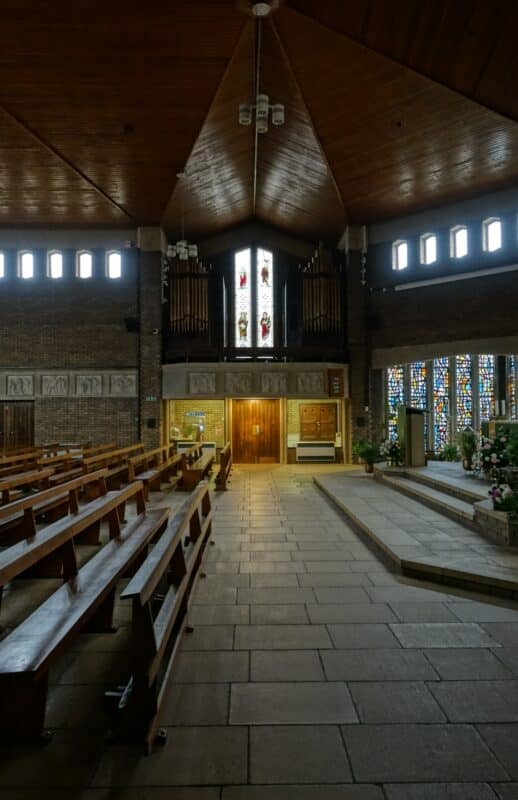

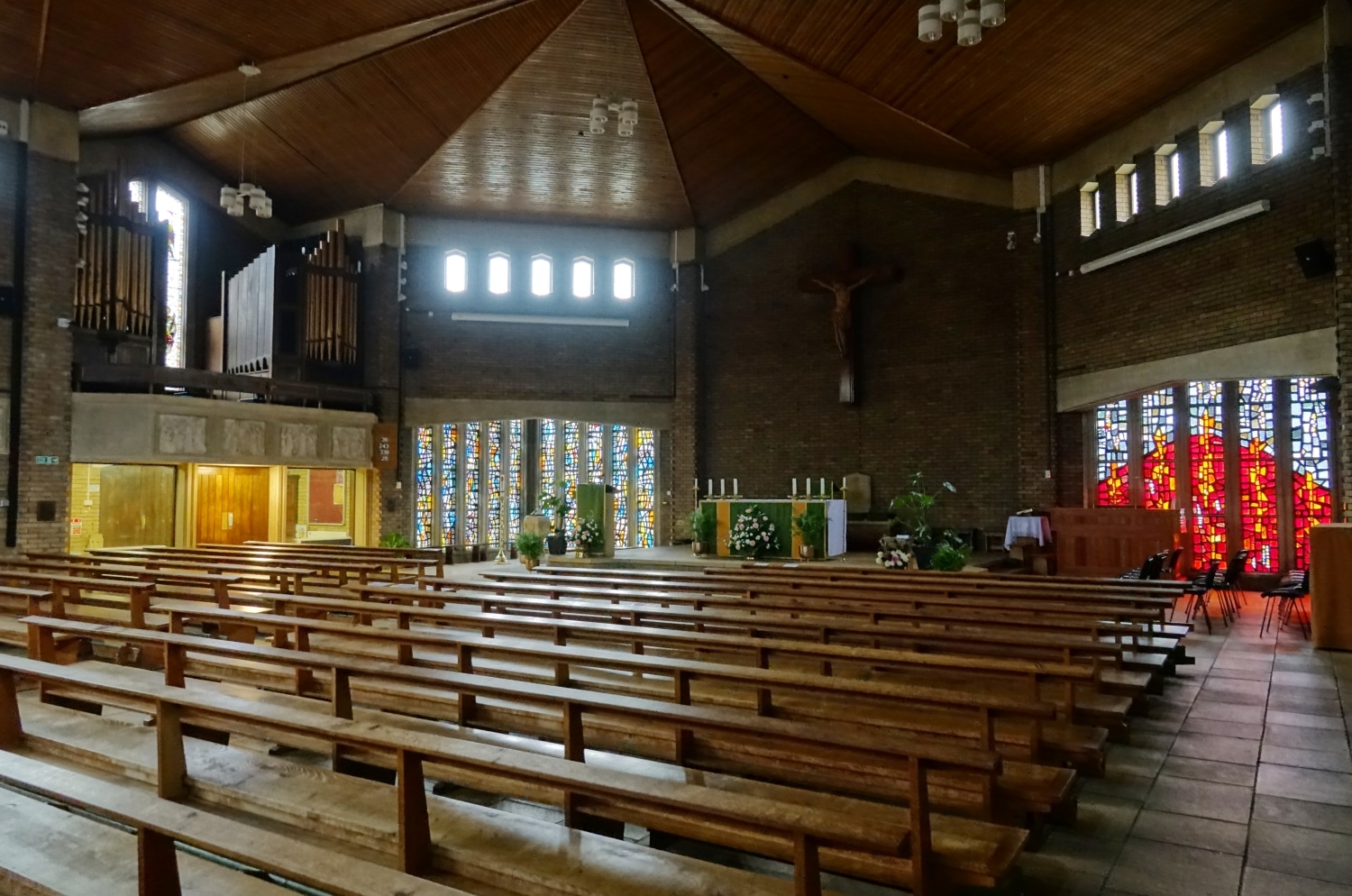
Foto’s: Andrew Wood © 2024
Henry Ainscough bouwde omstreeks 1930 een nieuw elektro-pneumatisch kegelladen-orgel met 20 stemmen, 2 manualen en een vrij pedaal voor de Roman Catholic Church of the Holy Rood in Swindon (Wiltshire) UK. George Osmond bouwde het instrument in 1971 om na een uitbreiding van de kerk. Er werd een nieuwe vrijstaande speeltafel geplaatst met een radiaal concaaf pedaalklavier. Het Bourdon-register van het Great en het Pedal werd verwijderd. Norman Hall & Associates wijzigde in het jaar 2000 de dispositie en plaatste een Swell Octave-koppel en een Swell Octave to Great-koppel. De stemmingstemperatuur is gelijkzwevend.
Dispositie:
GREAT (C – a3) 58 TOETSEN: Open Diapason 8′, Bourdon 8′, Flauto Dolce 8′, Principal 4′, Wald Flute 4′, Fifteenth 2′, Sesquialtera II (2000), Mixture III (2000), Tremulant.
SWELL (C – a3) 58 TOETSEN (IN ZWELKAST): Open Diapason 8′, Dulciana 8′, Voix Celeste 8′ TC, Clarabella 8′, Principal 4′, Block Flute 2′, Cornopean 8′, Tremulant.
PEDAL (C – f1) 30 TOETSEN: Gravitas 32′ A (2000), Subbass 16′ A, Principal 8′ B (2000), Posaune 16′ (2000), Posaune 8′ (2000).
KOPPELINGEN: Swell to Pedal, Swell to Great, Swell suboctave to Great, Swell octave, Swell suboctave, Great to Pedal.
SPEELHULPEN: 6 adjustable thumb pistons to both manuals; (3 to each before 2000); 6 toe pistons; 1 reversible toe piston for Posaune 16; reversible Great to Pedal thumb piston; 1 General Cancel piston.